
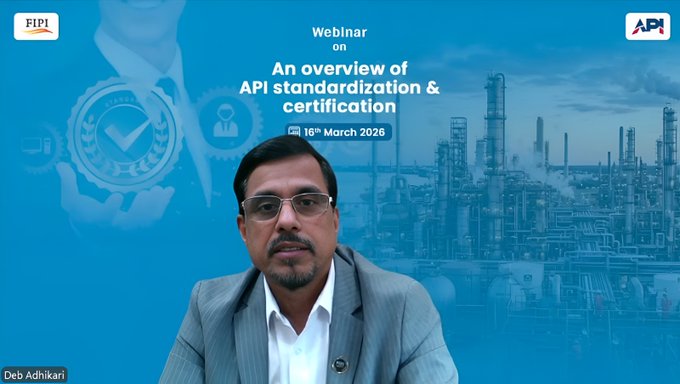
Mr. Deb Adhikari, Director (Exploration & Production), FIPI, in his opening remarks welcomed the eminent speakers from the American Petroleum Institute (API) and all the participants.
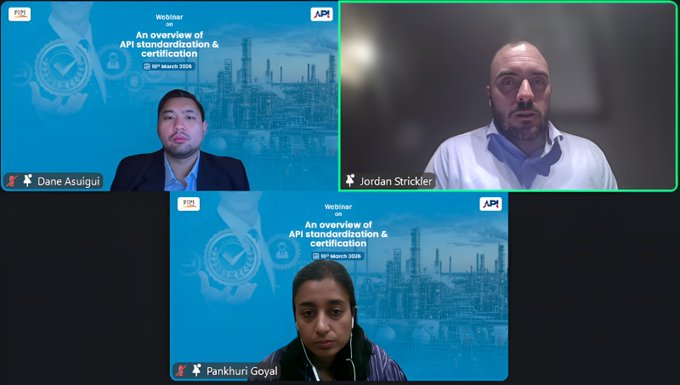
Mr. Dane Asuigui and Mr. Jordan Strickler from the American Petroleum Institute (API) shared their expert insights through an engaging presentation during the webinar on “An Overview of API Standardization & Certification.”
16-March-2026
Mr. Deb Adhikari, Director (E&P), FIPI began the session with the opening remarks. He mentioned that because of the extreme operating conditions in oil and gas industry like high pressure, high temperature or excessively corrosive environment, the safety, reliability, and the consistency are essential in this industry. Thus, standardization becomes very essential. Improved safety, interoperability, and efficiency are an inbuilt process of the API standards and that provides the credibility. He also said that the API certification also offers a unique trust and credibility for the designers as well as the operators, process auditors across the countries, companies, or projects without any compatibility issues. Thus, the API standards play an important role in supporting the global trade and industry growth of the oil and gas industry.
Mr. Dane Asuigui, Program Manager- Downstream Standards, API began with his presentation by highlighting that the first published API standard was on steel and iron piping in 1924, five years after the end of the First World War. Since then, API has its world-wide presence with multiple offices around the world. He said that API provides world-class services that enable the oil & natural gas industry to operate efficiently, safely, reliably, and sustainably thereby enhancing API’s advocacy potency. He mentioned that API standards are accredited by the American National Standards Institute. API has over 800 standards that are developed by 10,000 volunteers across the globe including India. Further, he said that these standards are led by committees that cover all segments of the industry- including upstream, midstream, downstream, and low carbon technologies.
Further, he mentioned that API has many Committees such as Committee on Standardization of Oilfield Equipment & Operations, Drilling & Production operations, Committee on Petroleum Measurement (COPM), Committee on Pipeline Standards, Committee on Refinery Equipment, Safety & Fire Protection Group. These committees ensure safety, environmental progress, equipment reliability, and consistency across upstream, midstream, and downstream operations.
Further he mentioned that API standards are not only important to engineers and users in the industry, but also important in government regulation. Every year, API standards international usage report is published on API website, which can be accessed for free. In addition, 650 US federal references from US govt. organization such as US Coast Guard, US EPA, FTC, BSEE, OSHA and PHMSA as well as 3800 references at state level are being used currently across all 50 states. Talking about internationally, 1,700 references across different governmental agencies, as well as ISO standards are being used in countries such as India, Canada, Mexico, Brazil, Guyana, Indonesia, Australia, Japan and many more.
Then he talked about the API standards development process which consist of five stages. The first step is when the Committees identify the needs for a new standard. Then, the committee would launch a task group to draft the new standard. Once the draft is completed, it goes to a ballot, which is consensus-based and allows the committee members to review the ballot draft or the draft of the document, provide comments on the content & then finally, can vote to approve or not accept it. If it is approved, it will go through the next stage, which is comment resolution. This allows the committee to review all the comments that have been submitted to the ballot, after which the standard is published, which is maintained through a five-year cycle. This means that the standard will be revised in every 5 years to be updated with any new information/innovation in the industry.
He also talked about the API Monogram Program, which is a premier quality certification for oil and gas industry manufacturers, certifying that equipment meets strict API specifications and that the facility adheres to API Spec Q1 quality management standards. Engine Oil Licensing and Certification System (EOLCS) Program, is a licensing and certification program for engine oil and diesel exhaust fluid and backed by monitoring & enforcement plan. He then talked about the API's Individual Certification Program (ICP) that has provided the petroleum and petrochemical industries with an independent and unbiased way to evaluate the knowledge and experience of technical and inspection personnel.
Talking about Indian engagement, Mr. Jordan Strickler, Senior Manager, Global & Low Carbon Strategy, API mentioned that India is API’s top countries who not only use API standards, but also use the monogram program for the manufacturing of equipment, in addition to individual certification program. Currently, API has 80 Indian-based experts participating in over 125 groups and API standards are being referenced in Indian regulations, standards, and policies over 90 times. Further API has signed MoUs with OISD, PNGRB, and FIPI to facilitate technical exchange, guide on the usage of API standards and programs, and identify areas for joint events.
Lastly, he said that API is focusing on low carbon technologies in areas of CCUS, Hydrogen, renewables & electrification, and greenhouse gas management wherein API conducts pre- standardization activities, and updates existing standards to incorporate and develop new guidance. API currently has a standard for offshore wind for safety and environmental management systems, CO2 pipeline guidance, and geothermal well drilling, etc.
Mr. Dane Asuigui and Mr. Jordan Strickler, then conducted the Q&A session and provided their views and opinions on various queries posted by participants.
Lastly, FIPI complimented the API team for an elaborative presentation and thanked the participants from the student chapters and energy industry for their active and interactive participation during the event.
Webinar on Consultation paper on “Framework for Leasi..
Global Energy Leadership Dialogue - 'Energy Security Re..
Webinar on Recent Judicial Developments in Internationa..
Webinar on API Low Carbon Standards ..
14th Annual Convention of FIPI Student Chapters ..
Webinar on Oilfield Equipment Leasing- a permissible ac..
Webinar on “LNG at the Crossroads: Fundamentals and P..
Webinar on An overview of API standardization and certi..
FIPI Post Budget Analysis 2026..
FIPI Annual Awards 2024-25- A Glimpse of Winners..